
Andrew Ng’s Machine Learning Specialization, Deep Learning Specialization, and IBM’s Machine Learning with Python led the best machine learning courses on Coursera in 2026.
These top-rated courses combine theoretical knowledge with practical implementation, ensuring you gain both understanding and hands-on experience.
I’ll guide you through the top 10 machine learning courses on Coursera, detailing each course’s content, requirements, and target audience, and then help you select the right path for your journey into machine learning.
Note: Course details and ratings reflect the most recent data available online and may fluctuate over time. Opinions expressed are based on available information and user reviews.
What Is The Best Machine Learning Course On Coursera?
Andrew Ng’s Machine Learning Specialization stands out as the best overall machine learning course on Coursera based on user reviews and ratings.
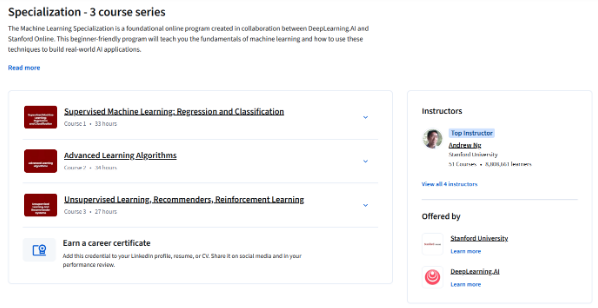
This detailed program covers the fundamentals of supervised and unsupervised learning, utilizing Python throughout, and provides the perfect foundation for anyone serious about machine learning.
Top 10 Best Machine Learning Courses On Coursera 2026
Here are the ten courses that will transform your understanding of machine learning and advance your career in 2026:
| No | Course Name | Instructor/Institution | Level |
|---|---|---|---|
| 1 | Machine Learning Specialization | Andrew Ng (DeepLearning.AI, Stanford) | Beginner |
| 2 | Deep Learning Specialization | Andrew Ng (DeepLearning.AI) | Intermediate |
| 3 | Machine Learning with Python | IBM | Beginner |
| 4 | Mathematics for Machine Learning | Imperial College London | Beginner-Intermediate |
| 5 | Introduction to Machine Learning | Duke University | Intermediate |
| 6 | IBM Introduction to Machine Learning | IBM | Intermediate |
| 7 | Machine Learning for All | University of London | Beginner |
| 8 | Supervised Machine Learning: Regression and Classification | DeepLearning.AI | Beginner |
| 9 | Developing Machine Learning Solutions | Amazon Web Services | Beginner |
| 10 | Advanced Machine Learning on Google Cloud Specialization | Google Cloud Training | Advanced |
Now, let me break down each course to help you make an informed decision about your machine learning education.
1. Machine Learning Specialization: Andrew Ng (DeepLearning.AI, Stanford)
This specialization provides the most detailed introduction to machine learning available on Coursera. The course covers regression, classification, clustering, anomaly detection, and neural networks.
| Level | Beginner |
| Duration | Approximately 3 months (10 hours per week) |
| Cost | Included with Coursera Plus (Financial aid available) |
| Who is it for? | Complete beginners to machine learning, software engineers transitioning to ML, and anyone seeking a thorough foundation in machine learning principles. |
| Certification Type | Specialization Certificate |
| Ratings | 4.9/5 stars (33,946 reviews) |
You’ll master both supervised and unsupervised learning techniques, work extensively with Python, and build models using NumPy, scikit-learn, and TensorFlow while learning Silicon Valley best practices for AI innovation.
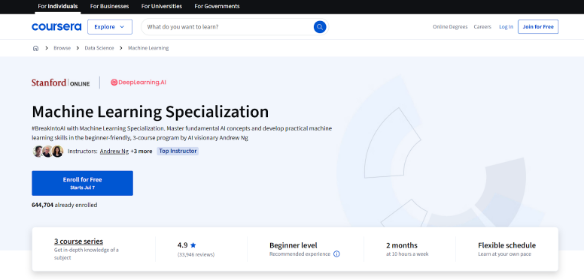
This updated version of Andrew’s pioneering course has been taken by over 4.8 million learners since 2012. Created in collaboration between DeepLearning.AI and Stanford Online, the three-course program covers supervised learning, neural networks, unsupervised learning, and reinforcement learning.
2. Deep Learning Specialization: Andrew Ng (DeepLearning.AI)
This five-course specialization covers neural networks, CNNs, RNNs, LSTMs, and Transformers using Python and TensorFlow.
| Level | Intermediate |
| Duration | Approximately 3 months (20 hours per week) |
| Cost | Included with Coursera Plus (Financial aid available) |
| Who is it for? | ML practitioners ready to advance into deep learning, data scientists working with complex datasets, and engineers building AI applications. |
| Certification Type | Specialization Certificate |
| Ratings | 4.9/5 stars (136,301 reviews) |
You’ll master advanced techniques like dropout, batch normalization, and optimization algorithms while building real-world applications, including speech recognition, chatbots, and natural language processing.
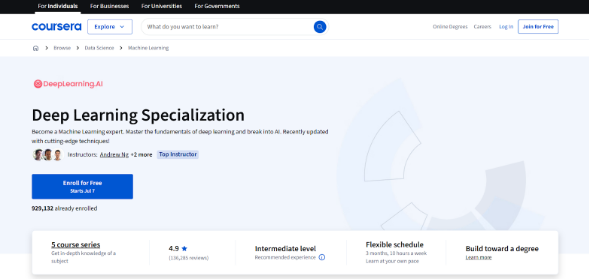
The program includes hands-on projects in computer vision, sequence modeling, and modern transformer architectures. Recently updated with cutting-edge techniques, it prepares you for leading-edge AI development with career guidance from industry experts.
3. Machine Learning with Python: IBM
This practical course focuses on implementing machine learning algorithms using Python and scikit-learn for real-world applications.
| Level | Intermediate |
| Duration | 20 Hours |
| Cost | Included with Coursera Plus (Financial aid available) |
| Who is it for? | Python developers entering ML, data analysts expanding their skills, and professionals needing hands-on ML experience quickly. |
| Certification Type | Professional Certificate |
| Ratings | 4.7/5 stars (17,461 reviews) |
This six-module course covers regression techniques, supervised learning models like decision trees and K-Nearest Neighbors, and unsupervised learning, including clustering and dimensionality reduction.
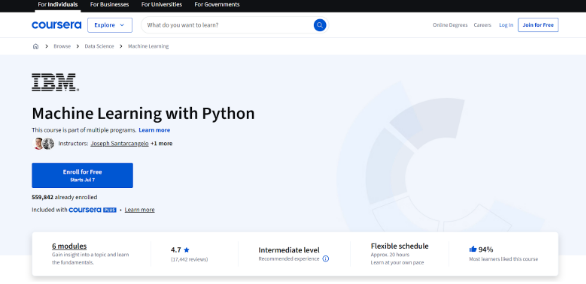
You’ll work with real-world datasets using Jupyter Notebooks, practice model evaluation and cross-validation, and complete a final rainfall prediction project. The course emphasizes practical implementation over theory, making it ideal for learners who want to start building ML models with Python and scikit-learn quickly.
4. Mathematics for Machine Learning: Imperial College London
This specialization provides the essential mathematical foundation needed for advanced machine learning and data science courses.
| Level | Beginner |
| Duration | Approximately 1 month (10 hours per week) |
| Cost | Included with Coursera Plus (Financial aid available) |
| Who is it for? | Students preparing for advanced ML courses, professionals needing mathematical refreshers, and anyone wanting to understand the math behind machine learning algorithms. |
| Certification Type | Specialization Certificate |
| Ratings | 4.6/5 stars (13,159 reviews) |
This three-course specialization covers linear algebra, multivariate calculus, and principal component analysis with intuitive explanations relating to machine learning applications.
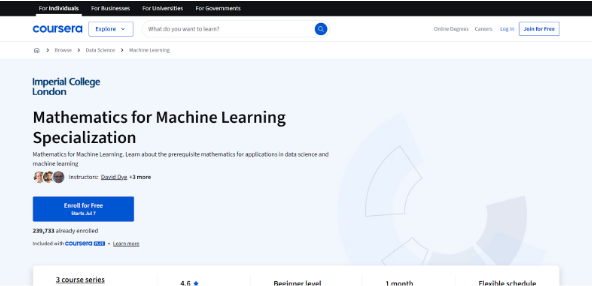
You’ll work with Python and NumPy through interactive notebooks, completing projects like calculating PageRank algorithms, training neural networks, and performing dimensionality reduction on MNIST datasets. The program bridges the gap between academic mathematics and practical ML implementation, building foundational knowledge for advanced courses.
5. Introduction to Machine Learning: Duke University
This comprehensive course demonstrates how machine learning models solve complex real-world problems across various industries.
| Level | Intermediate |
| Duration | Approximately 25 hours |
| Cost | Included with Coursera Plus (Financial aid available) |
| Who is it for? | Students with some technical background, professionals exploring ML applications, and those wanting hands-on experience with modern ML frameworks. |
| Certification Type | Course Certificate |
| Ratings | 4.7/5 stars (3,731 reviews) |
This six-module course covers logistic regression, multilayer perceptrons, convolutional neural networks, and natural language processing using PyTorch. Understanding the difference between specialization and professional certificates can help you choose the right program type for your career goals.
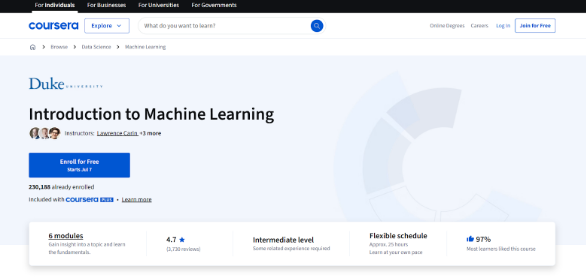
You’ll gain hands-on experience implementing algorithms used by leading tech companies like Google, NVIDIA, and Uber. The course emphasizes practical applications in medical diagnostics, image recognition, and text prediction, with 24 assignments providing extensive practice with real datasets and industry-standard tools.
6. IBM Introduction to Machine Learning: IBM
This specialization focuses on practical machine learning applications through real-world use cases and hands-on projects.
| Level | Intermediate |
| Duration | Approximately 2 months (10 hours per week) |
| Cost | Included with Coursera Plus (Financial aid available) |
| Who is it for? | Career changers entering ML fields, business professionals identifying ML opportunities, and students building portfolios for job applications. |
| Certification Type | Professional Certificate |
| Ratings | 4.7/5 stars (467 reviews) |
This four-course program covers exploratory data analysis, supervised learning (regression and classification), and unsupervised learning techniques. This course is ideal for individuals seeking to delve into advanced artificial intelligence.
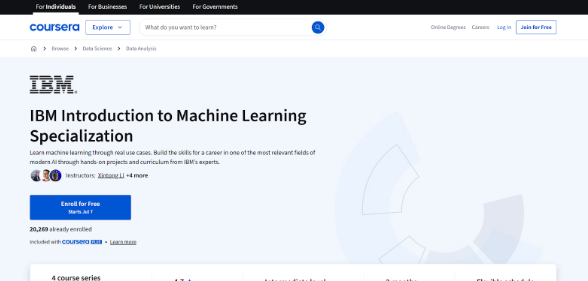
You’ll develop technical skills in SQL and machine learning modeling while learning to communicate findings to both technical and non-technical audiences. The specialization includes portfolio-building projects and prepares you for the complete IBM Machine Learning Professional Certificate program.
7. Machine Learning for All: University of London
This non-programming introduction to machine learning focuses on conceptual understanding rather than technical implementation.
| Level | Beginner |
| Duration | 20 hours |
| Cost | Included with Coursera Plus (Financial aid available) |
| Who is it for? | Complete beginners, managers, non-technical professionals wanting ML understanding without programming |
| Certification Type | Course Certificate |
| Ratings | 4.3/5 stars |
Students learn fundamental ML concepts, the impact on results, and use visual tools to train models for image recognition. The course emphasizes practical applications and societal implications of AI technology.
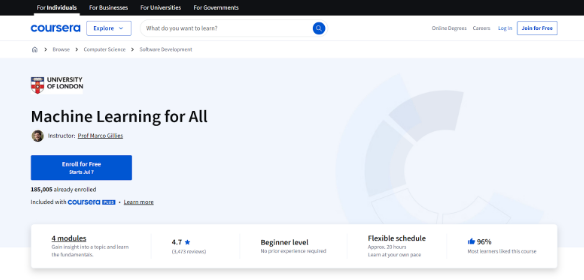
Perfect for professionals seeking to understand ML without coding requirements. Includes hands-on projects using user-friendly platforms developed at Goldsmiths.
8. Supervised Machine Learning Regression and Classification: DeepLearning.AI
This foundational course offers hands-on experience with Python programming using industry-standard libraries, including NumPy and scikit-learn.
| Level | Beginner |
| Duration | Approximately 33 hours |
| Cost | Included with Coursera Plus (Financial aid available) |
| Who is it for? | Python developers wanting to implement ML algorithms, data analysts transitioning to machine learning, and professionals seeking hands-on ML experience. |
| Certification Type | Professional Certificate (part of Machine Learning Specialization) |
| Ratings | 4.9/5 stars (28,968 reviews) |
Students build and train supervised learning models, including logistic regression and decision trees, while working with Jupyter notebooks. Taught by renowned AI expert Andrew Ng, the course emphasizes practical implementation and real-world applications as part of the Machine Learning Specialization.
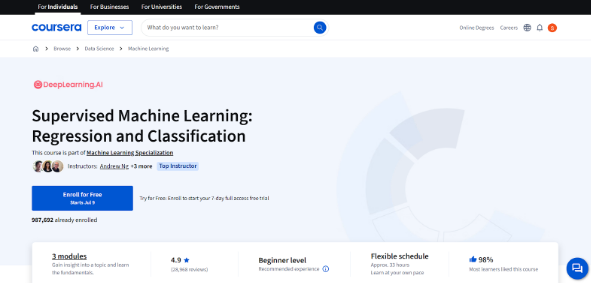
Content covers statistical modeling, predictive analytics, and binary classification tasks. This updated version of Stanford’s famous ML course, taken by over 4.8 million learners, provides excellent preparation for AI careers with modern tools and methodologies essential for machine learning engineering roles.
9. Developing Machine Learning Solutions: Amazon Web Services
This concise course covers the complete machine learning lifecycle using Amazon Web Services ecosystem and MLOps practices.
| Level | Beginner |
| Duration | Approximately 1 hour |
| Cost | Free |
| Who is it for? | Cloud developers, AWS practitioners, ML engineers working with cloud platforms |
| Certification Type | Professional Certificate |
| Ratings | 4.5/5 stars (57 reviews) |
Students learn AWS SageMaker, cloud-based model development, deployment strategies, and performance evaluation techniques within the AWS infrastructure. The curriculum emphasizes practical cloud development skills, predictive modeling, and diverse ML model sources with evaluation methods.
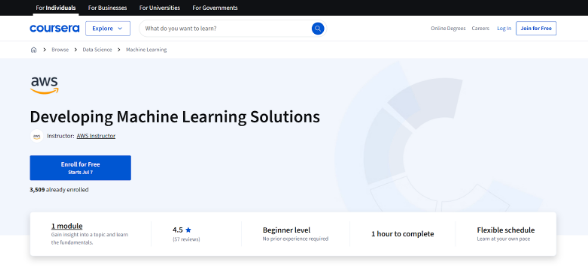
Content focuses on machine learning operations, streamlining development and deployment processes. Ideal for professionals working with cloud platforms or seeking an understanding of enterprise ML deployment.
10. Advanced Machine Learning on Google Cloud Specialization: Google Cloud Training
This four-course specialization targets experienced practitioners seeking production-ready machine learning skills with TensorFlow on Google Cloud Platform.
| Level | Advanced |
| Duration | Approximately 1 month (10 hours per week) |
| Cost | Included with Coursera Plus |
| Who is it for? | Experienced ML practitioners, cloud engineers working with Google Cloud, and professionals building production ML systems at scale. |
| Certification Type | Specialization Certificate |
| Ratings | 4.5/5 stars (1,973 reviews) |
Students engage in hands-on Qwiklabs exercises covering advanced topics including model optimization, computer vision fundamentals, natural language processing, and recommendation systems.
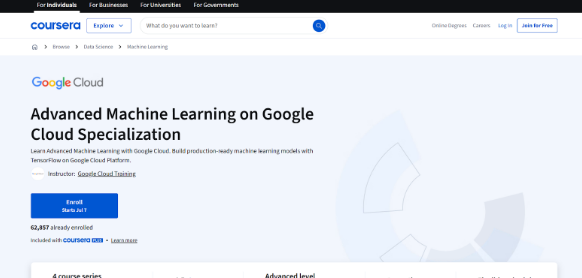
requires sequential completion for optimal learning progression and emphasizes real-world applications using cutting-edge Google Cloud technologies. Perfect for professionals advancing from intermediate to expert level while building enterprise-grade solutions with the Keras framework and advanced ML algorithms, including reinforcement learning.
This course is also available through free Google certification courses initiatives.
Coursera Pricing For Courses
Coursera offers flexible pricing, ranging from free courses to $49 per month subscriptions. Professional certificates start at $49 per month, degrees cost $9,000, and Coursera Plus provides unlimited access to over 7,000 courses.
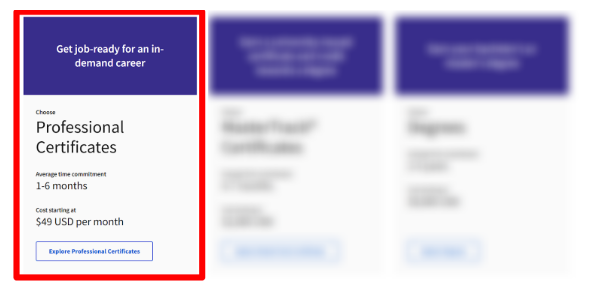
Coursera Plus subscription offers unlimited course access. Coursera offers financial aid to qualifying learners and provides free trials for paid subscriptions. Many courses include free content, with hundreds of completely free courses available alongside premium paid options.
For more information about costs and subscription options, refer to the detailed Coursera pricing guide.
Which Machine Learning Course Is Best For You?
Choosing the right course depends on your background, goals, and learning style. Here’s how to match your profile:
- Beginners: Start with Andrew Ng’s Machine Learning Specialization for detailed foundations, or choose IBM’s Machine Learning with Python for immediate practical skills.
- Intermediate Learners: Deep Learning Specialization advances your neural network knowledge, while Duke’s Introduction to Machine Learning offers broad coverage.
- Math-Focused Students: Imperial College’s Mathematics for Machine Learning provides a solid theoretical foundation before delving into algorithms and implementations.
- Cloud-Focused Professionals: AWS’s Developing Machine Learning Solutions teaches MLOps and cloud deployment skills essential for modern ML engineering roles.
Before committing, consider taking advantage of a Coursera free trial to explore the course content and teaching style.
Is A Machine Learning Certificate Worth It?
Machine learning certificates provide significant value in today’s competitive job market. Here are five compelling reasons to pursue certification:
- Career Advancement: ML certificates open doors to higher-paying roles and leadership positions in data science teams.
- Skill Validation: Certificates provide concrete proof of your machine learning competencies to employers and clients.
- Industry Recognition: Major companies recognize Coursera certificates from top universities and industry leaders like Andrew Ng.
- Portfolio Building: Course projects create a strong portfolio showcasing your practical machine-learning abilities and completed work.
- Networking Opportunities: Certificate programs connect you with peers, instructors, and industry professionals, expanding your professional network.
Upon completion, you’ll want to know how to properly add your Coursera certificate to LinkedIn to showcase your new expertise to potential employers.
Are Coursera Certificates Worth It?
Coursera certificates specifically offer unique advantages in online learning. Here’s why they’re particularly valuable:
- University Partnerships: Certificates from Stanford, Imperial College, and Duke carry academic prestige and institutional credibility.
- Industry Connections: IBM, AWS, and Google certificates directly connect to job opportunities within these major technology companies.
- Flexible Learning: Complete courses on your schedule while maintaining work or family commitments without sacrificing quality.
- Practical Projects: Coursera emphasizes hands-on learning with real-world projects that demonstrate your capabilities to employers.
- 5. Ongoing Support: Access to course materials, community forums, and career services continues long after course completion.
Also Read:
Conclusion: Andrew Ng’s Courses Lead 2026’s Best ML Education!
Andrew Ng’s specializations top the list, while IBM, AWS, and university courses provide specialized paths for different career goals.
Remember that consistency and practice matter more than course selection. Choose a course that matches your current level, commit to regular study, and apply your learning through projects.
Ready to start your machine learning journey? Browse these courses on Coursera today and take the first step toward your new career in artificial intelligence.
FAQs
The big 3 of machine learning are supervised learning, unsupervised learning, and reinforcement learning.
You can learn machine learning fundamentals in 3 months with dedicated study (10-15 hours per week).
Python is the most popular programming language for AI and machine learning, followed by R for statistical analysis.
Start with Python programming fundamentals, then learn basic statistics and linear algebra.
The three C’s of machine learning are Classification (categorizing data into groups), Clustering (grouping similar data points), and Correlation (identifying relationships between variables).
